Voyager 1 Reaches One Light-Day Distance
NASA's oldest active spacecraft will cross the 16-billion-mile mark on Wednesday, a milestone in its decades-long journey through interstellar space.
By Ariana Flores ·
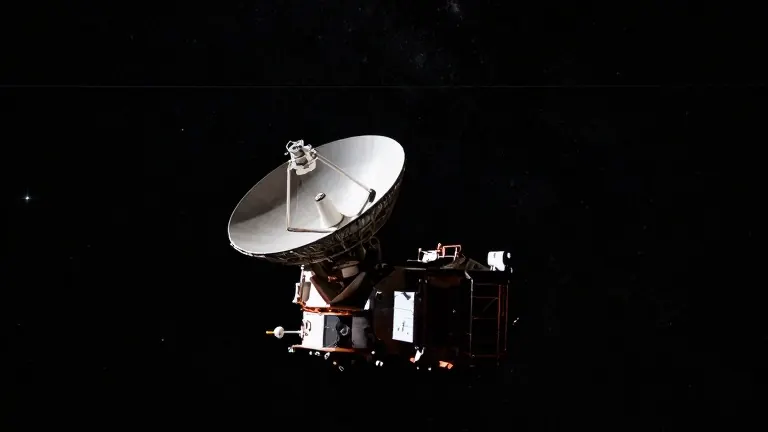
NASA’s Voyager 1 spacecraft will become the first human-made object to travel one light-day from Earth on Wednesday. The probe is moving through interstellar space at a distance of more than 16 billion miles from its launch point. At this range, radio signals sent by the spacecraft take exactly 24 hours to reach Earth at the speed of light.
Voyager 1 launched in 1977, making it 49 years old. It is one of two identical probes designed to study the outer solar system. Voyager 2, launched two weeks after its twin, will not reach the same one-light-day distance until 2035. Both spacecraft continue to travel at approximately 38,000 miles per hour, though they are heading in different directions.
Project manager Suzanne Dodd described the mission as a source of wonder for the public. She characterized the spacecraft as a national treasure and Earth’s ambassador to the space between stars. Dodd has worked on the Voyager program since 1984 and noted that the probes function similarly to weather satellites, sending back daily data on magnetic fields, pressure, dust, and cosmic rays.
The spacecraft have operated for nearly five decades with a small team at NASA’s Jet Propulsion Laboratory in Pasadena, California. Controllers send commands roughly once a week to maintain operations. In September, engineers completed a power-conserving procedure for the plutonium-powered systems. In October, contact with Voyager 1 was briefly lost, and teams are currently investigating the cause of the disruption.
Voyager 1 flew past Jupiter in 1979 and Saturn in 1980 before exiting the solar system in 2012. It holds the Guinness World Record for the farthest distance traveled by a human-made object. In 1990, the probe captured the famous image of Earth known as the Pale Blue Dot from a vantage point beyond Neptune. Astronomer Carl Sagan, who was part of the imaging team, popularized that photograph.
NASA is inviting the public to mark the milestone on Tuesday evening. Observers are encouraged to use flashlights or phone screens to create a wave of golden light after sunset. Participants should use Morse code to spell V-G-R, the call sign for Voyager, into the night sky. Each spacecraft carries a gold-plated phonographic record containing greetings in 55 languages, images, and sounds from Earth.
The records were designed as a time capsule for potential future finders. They include a stylus and instructions for playback. Bill Nye of The Planetary Society stated that the missions have touched everyone on Earth. Dodd expressed hope that someone may discover the records 1,000 years from now.
More Tech · San Antonio news · Report a business · Got a Story?