Trinity alumni trace Butthole Surfers origins to campus punk scene
A new documentary explores how Paul Leary and Gibby Haynes formed the influential band within the university's eclectic arts culture.
By David Marshall ·
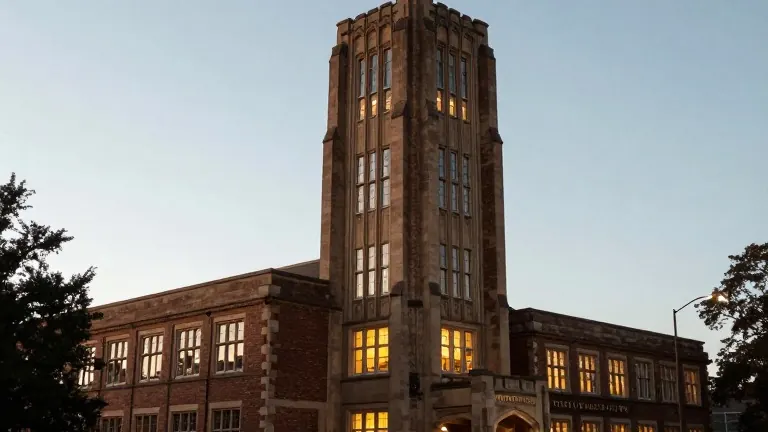
A new documentary, 'Butthole Surfers: The Hole Truth and Nothing Butt,' premiered in streaming format this week, focusing on the formation of the punk band at Trinity University. The film features Paul Leary, a 1980 graduate and lead guitarist, who describes his time as a business student and a self-proclaimed oddball. Leary met Gibby Haynes, a 1981 accounting graduate and standout basketball player, on campus. The two shared an interest in avant-garde art and punk music, leading to the creation of the band that would later influence artists like Kurt Cobain and Dave Grohl.
Haynes reflects on the era in the documentary, stating, 'It was so much fun, man, in those days, late ’70s at Trinity.' The university environment allowed students to pursue business careers while exploring artistic interests. David Elizondo, a 1978 graduate and 1986 master's graduate, noted that other institutions often forced students onto rigid paths. 'A lot of universities put you on a path, and you have to stay on that,' Elizondo said. 'Anything outside of that, you’ll cause problems. Nobody wants problems.'
Elizondo, a San Antonio artist who returned to Trinity after serving in the U.S. Navy in Vietnam, connected with Leary and Haynes in an electronic music class taught by then-chair William Thornton. The group shared an appreciation for the abstract expressionist work of Marcel Duchamp. This artistic interest led them to incorporate performance art into their live shows. 'We did guerrilla art on campus,' Elizondo recalled. 'We would do art and just leave it somewhere to get reactions.'
Michiko Sakai Smart, a 1983 graduate, first learned about the band through the local theater and music scene. She recalled a friend asking if she had seen the Butthole Surfers, noting the surprise that such a group existed at Trinity. 'Have you seen Butthole Surfers?' her friend asked. 'Butthole, what?' Smart replied. 'It’s a band at your school,' the friend said. 'My school? Trinity?' Smart attended her first show and became an avid follower. She later married Terence Smart, a 1984 graduate and one of the band's bassists.
Smart described the band's approach as intentionally ridiculous and artistically driven. 'This band just wanted to be ridiculous, artistically, and they behaved so badly!' she said. She emphasized the experiential nature of their concerts, noting, 'It’s not a matter of understanding. It’s a matter of experiencing. Just to be there, breathing the same air is the most important aspect.'
The band's first concert took place in an artists' space on Austin Street in San Antonio. The audience, composed largely of Trinity students, welcomed the performance's wild elements, including nude dancers wrapped in cellophane. Elizondo observed that the intellectual nature of the audience allowed them to categorize the show as avant-garde rather than just punk. 'The audience was geared for that type of stuff,' Elizondo said. 'When you have all these people doing this crazy stuff on the intellectual side, you call it ‘avant-garde,’ not ‘punk’.'
The group recorded their first album in a studio on Broadway in San Antonio between 1982 and 1983. Smart, who lived near the studio, provided a space for the band and guests. She contributed a scream to the song 'Cowboy Bob' and performed as a 'screamer' for several live shows. The band released nine studio albums over the years, with the song 'Pepper' reaching number one in 1991. A previously shelved album, 'After the Astronaut,' was released this year.
Elizondo and Smart have both contributed materials to Trinity’s Special Collections and Archives to preserve the era's history. Elizondo donated 129 items in 2024, including flyers, photographs, and zines, as part of the 'Conmemorando a la Comunidad' project. Smart donated digital reproductions of candid photos she took of the band in 1983. 'Having my work archived here at Trinity, it’s the foundation,' Elizondo said. 'I devoted my whole life to this work. It should be documented.' Smart added that the band's live performances were remarkable and needed to be seen to be understood.
More Culture · San Antonio news · Report a business · Got a Story?