537 Dead Penguins Found on Antarctic Ramp Led by Bacterial Infection, Not Bird Flu
Researchers identified avian cholera as the primary cause of death, challenging initial assumptions that the H5N1 virus was the main driver of the die-off in the Danger Islands.
By David Marshall ·
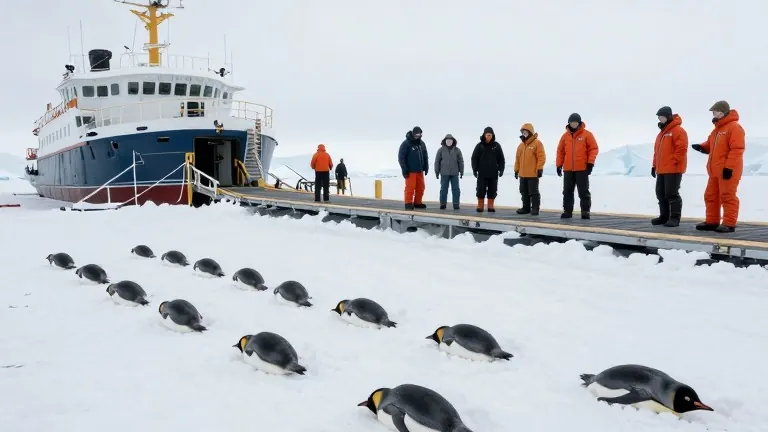
More than 537 Adélie penguin carcasses were discovered on a single landing ramp in the Danger Islands, an archipelago off the Antarctic Peninsula. The finding, reported by researchers in October, indicates that a bacterial infection, rather than the avian influenza virus, was the primary cause of the mass mortality event.
Dr. Ralph Vanstreels, a wildlife veterinarian at the University of California, Davis, led the expedition in March 2024. The team arrived expecting to find evidence of H5N1, which had reached Antarctica in late 2023. Vanstreels noted that the researchers had to search through snow to distinguish between rocks and dead birds. They estimated that thousands of additional Adélie penguins and other bird species died elsewhere on the islands, though a complete count was not possible due to time constraints and ice conditions.
Initial rapid tests performed on the research vessel revealed low viral loads of the bird flu virus in the deceased birds. Vanstreels stated that the low levels were puzzling because the carcasses were fresh. If H5N1 had been the primary killer, the team expected to find significantly higher concentrations of the virus. This discrepancy led researchers to look for alternative causes.
Subsequent analysis conducted in the Netherlands confirmed that bacteria were present in the penguin tissues. The team identified avian cholera, a bacterial disease distinct from human cholera, as the main driver of the outbreak. The findings were published in the Proceedings of the Royal Society B. Vanstreels explained that while the bird flu virus was present, it was not the sole cause of death.
The discovery offers context for the arrival of H5N1 in mainland Australia in June 2026. Australia had remained free of the virus until that point, making it the last continent to dodge the pathogen. Dr. Amandine Gamble, an assistant professor at Cornell University, noted that the virus likely arrived via migrating birds from Antarctica rather than from Southeast Asia. Michelle Wille, a senior research fellow at the University of Melbourne, described the virus as traveling through mass mortality events rather than via human transport.
Avian cholera has been known to scientists for decades, but the last time researchers looked for it in the Antarctic Peninsula was 25 years ago. Vanstreels suggested that die-offs caused by the bacteria may occur regularly but go undetected because monitoring efforts have focused on bird flu. The strain found in the penguins is very close to a strain found on Île Amsterdam in the Southern Indian Ocean, suggesting the continent is more connected to global disease networks than previously thought.
The Antarctic Treaty designates the continent as a zone for peace and science, with 58 parties including the United States, France, Japan, and Russia. Because no single government governs Antarctica, monitoring pathogens requires international collaboration. Gamble emphasized that the cholera outbreak demonstrates that such events are not unique and that continued international cooperation is necessary to track diseases that cross borders.