Jericho cement plant opens with 1.3 million ton capacity
Security experts warn the new facility could support underground construction while Israeli officials cite lack of prior coordination.
By Ariana Flores ·
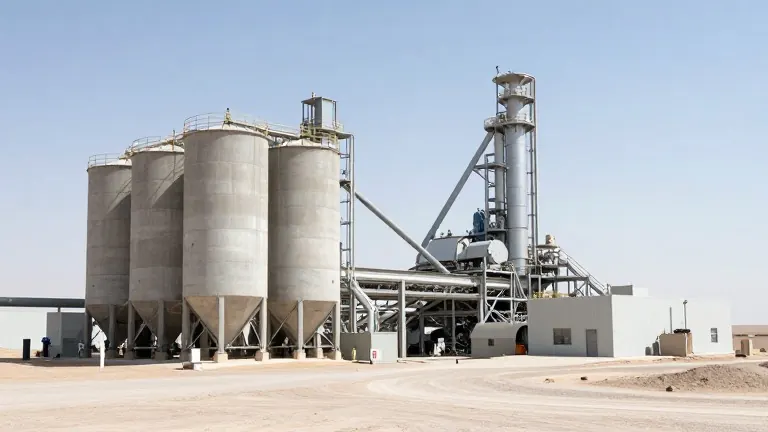
The Jericho Cement Industry Company began operations in the West Bank on Monday, marking the first cement production facility to open in Area A. The plant has a stated annual production capacity of 1.3 million metric tons and currently employs 100 workers. It was established through a joint venture between the Palestinian Sanad Company and the Jordanian Unifive Company, with support from the Palestinian Investment Fund and the Issa Khoury Group.
Palestinian Authority President Mahmoud Abbas formally inaugurated the facility. The project aims to reduce reliance on imported materials and create jobs within the local construction sector. Under the 1994 Paris Economic Protocol, cement is classified as a List A1 commodity. This designation previously capped imports from neighboring Arab countries at 400,000 metric tons annually, making Palestinian buyers heavily dependent on private Israeli suppliers for their needs.
Security analysts have raised concerns about the strategic implications of the new plant. Lt.-Col. (res.) Maurice Hirsch, a senior legal analyst at Human Rights Voices and director of the Initiative for Palestinian Authority Accountability and Reform, stated that unchecked cement production poses a security risk. He noted that cement can be used to construct underground infrastructure similar to the tunnel networks built by Hamas in Gaza. Those tunnels allowed for the movement and concealment of personnel and weapons, creating challenges for military operations during recent conflicts. Hirsch argued that such structures are difficult to detect using aerial intelligence alone.
The factory’s location in Area A complicates oversight mechanisms. Under the Oslo II Accord, the Palestinian Authority holds civil jurisdiction over this zone and issued the necessary permits for the project. Prof. Arie Reich of Bar-Ilan University’s Faculty of Law explained that Israel has no direct say in the process as long as the cement does not pose an immediate security risk. However, he noted that the dynamic changes if the material is destined for Gaza, where it is treated as a dual-use item with strict quantity limits.
Reich pointed to Annex I, Article II of Oslo II, which requires both parties to cooperate on preventive measures against terrorism. He stated that if Israel presents credible evidence linking specific cement shipments to an attack tunnel, it can demand a Palestinian investigation into buyers and end users. In the absence of such evidence, he said Israel is likely to take unilateral measures to mitigate the risk. A spokesperson for the Joint Economic Committee, the bilateral body governing economic relations under the Paris protocol, confirmed that no coordination had taken place regarding the project.
Hirsch criticized the Palestinian Authority for failing to meet past obligations. He referenced a July article detailing the authority’s military buildup and the potential threat it poses. He stated, "We have a limited amount of intelligence coverage and almost no supervisory jurisdiction. Palestinians can essentially do whatever they want." He described the cement industry as dual-use, calling it "an ostensibly innocent industry that could be very profitable, but can also be used for very nefarious purposes."
The expert also raised questions about trade dynamics. He noted that the majority of West Bank exports go to Israel. He argued that Israeli purchases of the new cement would not stop the Palestinian Authority from using the industry to pressure the international community for sanctions against Israel. The facility’s launch adds a new industrial component to the West Bank’s economy while introducing new variables into the regional security calculus.